
.svg)
%20(1).svg)
%20(3).svg)
Back to articles
9 Best AI Search Visibility Tools for Better AEO Insights
September 8, 2026
By
Irina Maltseva
In the past, SEO meant matching keywords with user intent and blue links, where people clicked through to know the answers. Today, things are quickly changing with the rise of AI search engines—these provide direct answers to user queries.
Modern algorithms focus on understanding the meaning behind search queries, instead of just matching keywords. This means you need to offer valuable and authoritative content to show up in AI search experiences.
For example, instead of keywords, such as "best travel destinations," you must focus on addressing specific user queries like "is [Country] safe for solo travelers?"
Understanding how AI search visibility works can help you build a solid AEO+GEO strategy.
In this guide, we'll review the AI visibility tools that provide SEO insights to help more people discover your brand.
Short on time? Here are the standout tools from this guide, each paired with the scenario it wins:
The detailed reviews below break down features, pros, cons, and pricing for all nine tools.
AI isn't just changing how you perform SEO. But it also impacts the tools and strategies you use to optimize brand visibility—including content, technical audits, and competitor analysis.
Investing in the right AI search visibility software can save you hours of manual work.
Below are 9 best tools for AI search visibility to help you understand what impacts your brand presence in AI search experiences.
AI search visibility is the process of understanding how often your brand appears in AI-powered searches. With this, you'll know how many times your brand's products, content, or services appear in LLM answers.
While traditional SEO aims to showcase your brand within a list of links, AI search visibility focuses on directly citing your content in AI search engines. Each marketing technique has different goals: increasing clicks for traditional SEO and earning trust through summarized answers in AI search engines.
AI search visibility specifically focuses on core metrics like:
Using a dedicated AI search visibility tracker can help you monitor these metrics and guide your SEO. But choosing a tool among many in the market can feel overwhelming.
That's why we've compiled a list of features and functionalities to look for in AI search visibility trackers. For businesses developing AI-powered solutions for these evolving search environments, Gen AI development services can also support the creation of tools tailored to specific AI search and visibility needs.
LLMs work on probability, meaning the outputs vary based on prompt phrasing, timing, and user behavior, amongst other variables. So, tracking these results manually is out of the question.
The best way is to find a tool for AI search visibility, one that does everything in a single place. For example, you might want to track brand visibility, run competitor and sentiment analysis, and optimize AI visibility in the same software.
With numerous tools hitting the market, it's important to look for the following features:
We evaluated multiple platforms, some as dedicated software and others as part of traditional SEO platforms.
Here are our top 8 AI search visibility tracking tools.
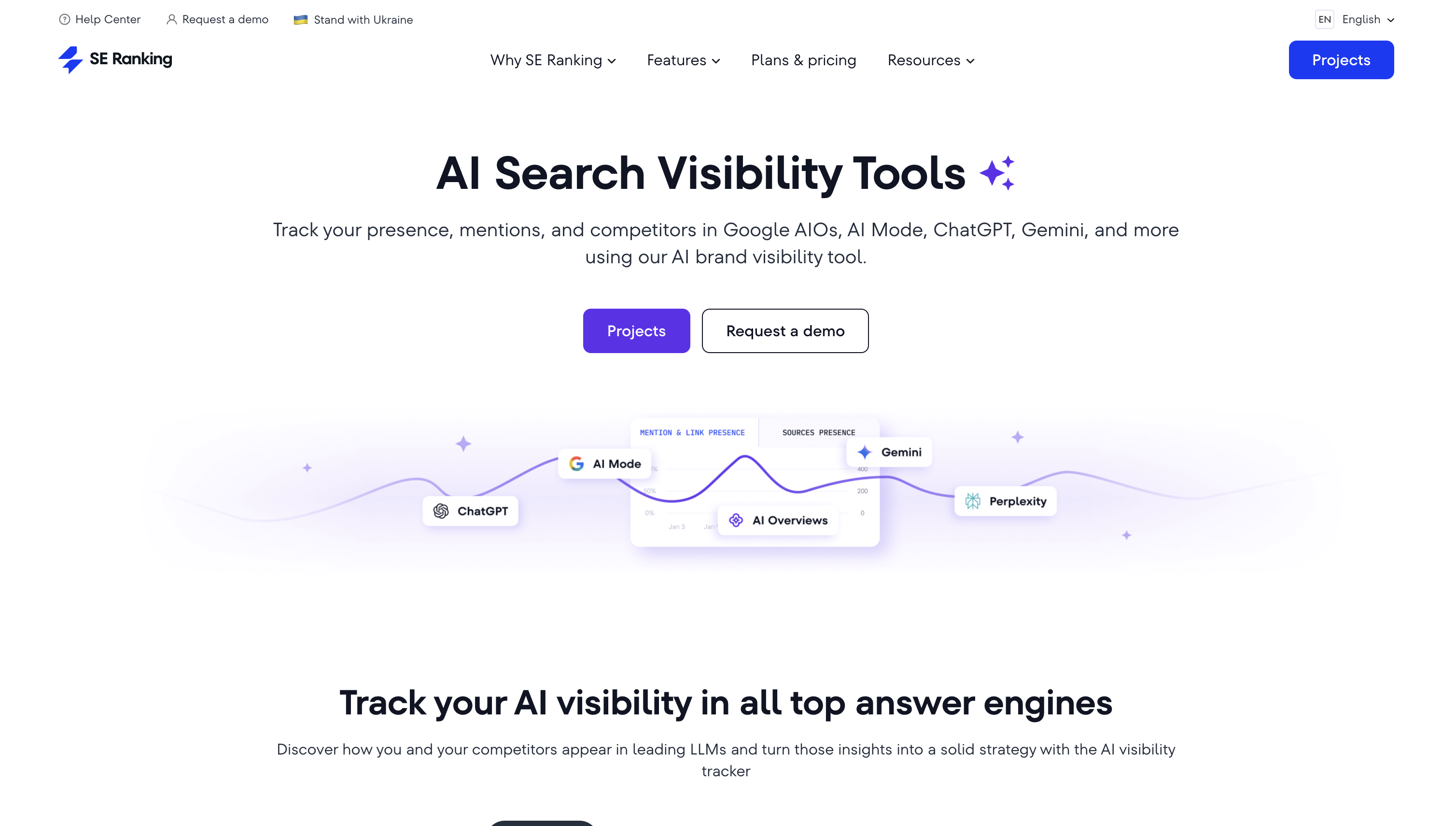
SE Ranking brings traditional and AI search strategies together in one powerful platform. Apart from its SEO monitoring and research features, SE Ranking features a powerful AI Search Toolkit that enables businesses to track and improve their visibility across AI-generated results. The tool covers platforms like Google AI Overviews, AI Mode, Gemini, and ChatGPT, soon expanding to Perplexity and others, making it the best AI search visibility tracker.
The platform helps users track how their brand is presented in AI answers, including mention frequency, link placement, and positioning in AI responses. It shows who else gets mentioned alongside your brand, where your competitors stand, and what pages get cited most often by AI. This tool makes it easier to measure your AI visibility, analyze competitors, and act on real data to improve your brand’s share of voice.
.svg)
Competitor tracking: Lets you monitor competitor brands and benchmark their visibility side-by-side.
Clear visibility metrics: Users can view positions, mentions, and link placements across AI answers.
Intuitive interface: The dashboard is clean, visual, and easy to navigate.
SEO integration: Works with your existing SEO projects, no need to switch platforms or duplicate work.
Intuitive interface: The dashboard is clean, visual, and easy to navigate.
.svg)
No sentiment analysis: The platform doesn’t yet analyze how AI models frame brand tone or sentiment. You can only check the AI answers to draw your own conclusions.
Mild learning curve: Some users may need a short learning curve to get used to AI-specific workflows.
Best for: teams already inside an SEO suite who want AI search tracking layered onto their existing projects without switching platforms.
The AI Search Toolkit is included in SE Ranking’s:
AI Results Tracker limits can be scaled with add-ons starting at $89/month. This add-on also gives you access to research competitors in AI search.
A 14-day free trial is available for new users, and annual plans come with a 20% discount.
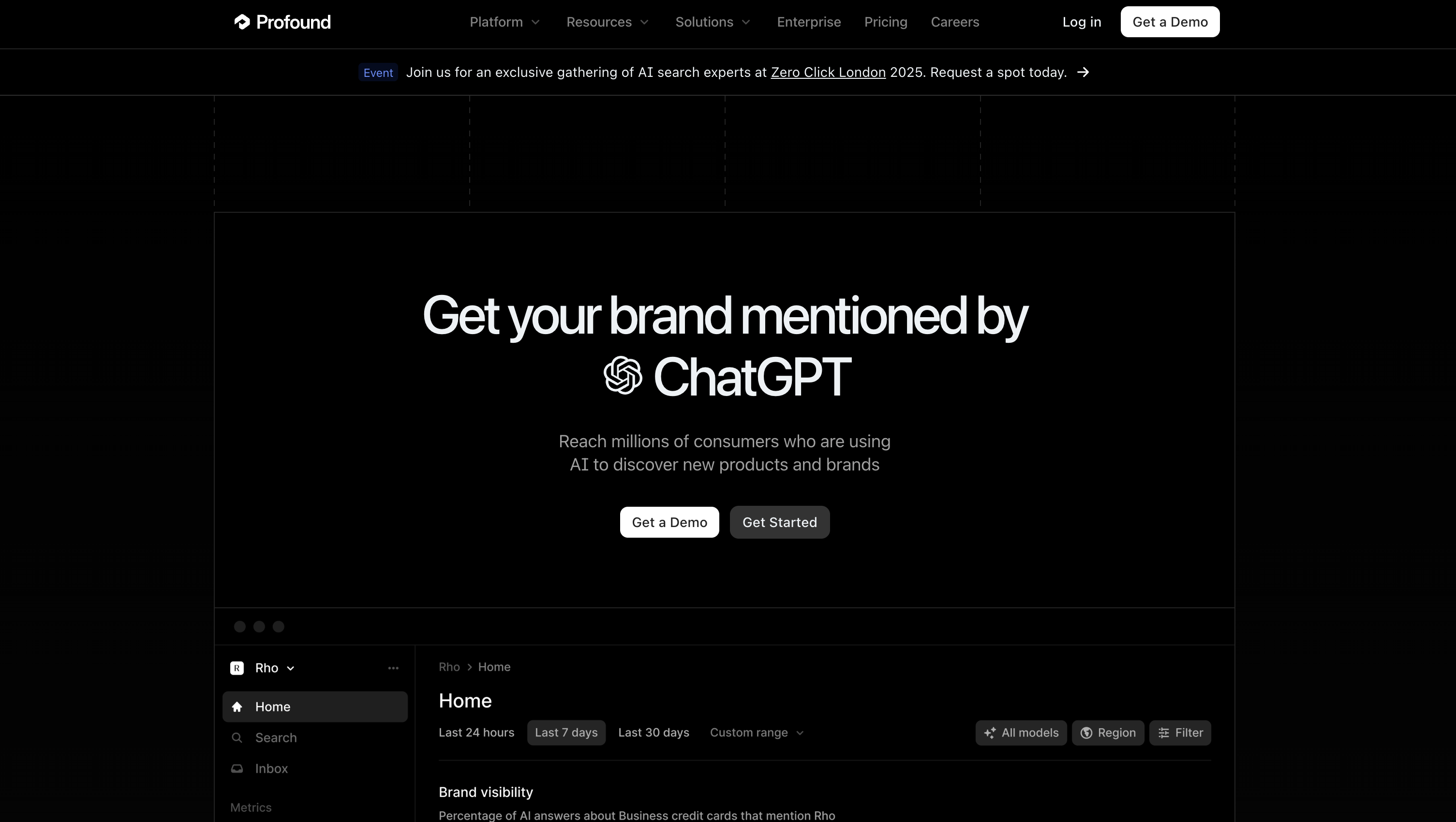
Profound AI is a unique AI search visibility tracking tool with dozens of proven formats to drive brand citations. From answer engine insights to conversation explorer, the platform gives you a hands-on experience with search visibility.
Another special feature is the ChatGPT shopping visibility that lets you analyze how your products level up in the sales space.
Clear insights: Customers appreciate Profound's ability to simplify complex data into actionable steps.
Simple user interface: Profound AI is known for its simple dashboards and specific growth insights.
Responsive customer care: Users are happy with Profound's prompt response to client queries and concerns.
Missing AI models: Profound AI does not track performance across Claude, Mistral, and Grok.
Lack of simpler report extractions: Some users find it challenging to export scores, citation ranks, and search volume data.
Lack of advanced data: Certain other customers find a need for more data, such as organic and paid search results.
Best for: enterprise teams that want deep answer-engine insights and ChatGPT shopping visibility, and can justify a premium price.
Although Profound can be considered one of the best AI search visibility tracking tools, it only offers two pricing tiers:
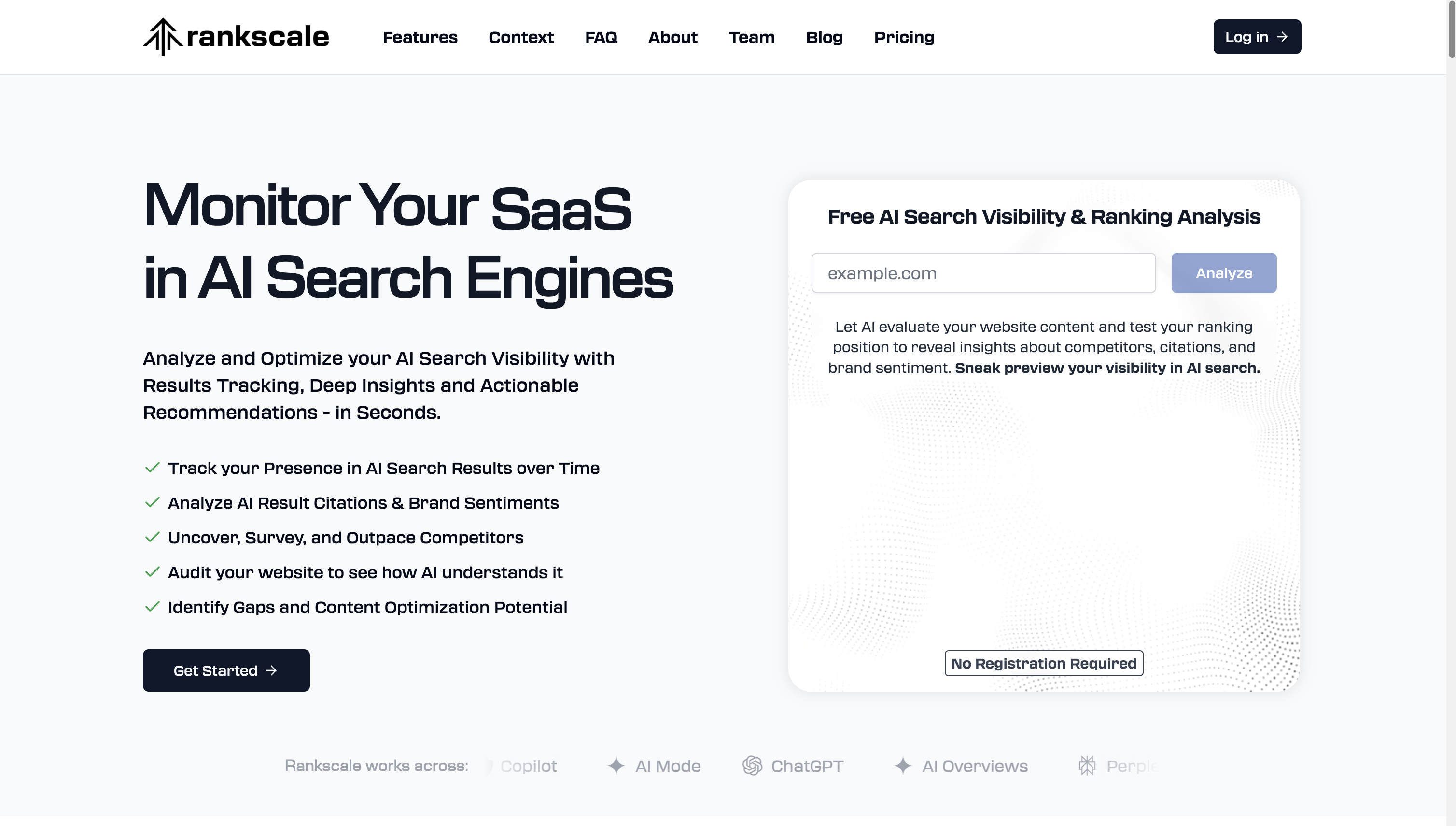
Ranskcale AI helps track your brand presence in conversational search engines like ChatGPT and Perplexity. The platform provides a dynamic dashboard to track all your brands, including performance metrics, competitor analysis, and period-over-period comparisons.
Simple interface: Users like the intuitive dashboard and actionable insights.
Fast customer support: Rankscale's support is quick and easy to access.
Clear analytics: The tool provides a clear overview of scores, metrics, and other analytics.
Limited customization options: A few users are pretty unhappy with the lack of integration and customization options.
Long learning process: Customizing everything to your needs could take time.
Unclear views: There is no mention of what the person is looking at, and some users find the views confusing.
Best for: budget-conscious small teams that want visibility, sentiment, and competitor benchmarking starting at €20/month.
Ranscale AI offers the following pricing tiers:

Conductor is an enterprise-grade SEO and content intelligence platform designed to help brands increase organic visibility, uncover content opportunities, and measure impact across the search ecosystem. By combining robust keyword research, competitive insights, and real-time performance tracking, Conductor enables marketing teams to build search-optimized content strategies that attract and engage target audiences.
The platform integrates cross-channel data to inform strategy, uncover SEO opportunities, and guide content investment decisions that drive sustainable organic growth.
Comprehensive SEO toolkit covering research, execution, and measurement.
Actionable insights with clear recommendations based on real search demand and competitive benchmarks.
Collaboration features with team workflows and shared dashboards for better alignment.
Custom reporting with branded reports and exportable data for stakeholder presentations.
Enterprise-focused features and pricing may be more than small businesses need.
Learning curve due to the depth of functionality.
Best for: enterprise marketing teams that need enterprise-grade content intelligence and cross-channel data depth.
Conductor does not publicly list fixed pricing on its website; instead, it offers custom plans based on business size, goals, and feature requirements. Prospective customers can request a demo and pricing quote tailored to their needs.

OtterlyAI is an AI Search Monitoring and Optimization Platform built specifically for tracking how brands appear and are cited in AI-driven search experiences. Unlike traditional SEO tools extended into AI, OtterlyAI focuses natively on generative engines, making it well suited for teams prioritizing AEO and GEO outcomes over classic rankings.
The platform monitors brand mentions, website citations, and Search Prompts across ChatGPT, Perplexity, Google AI Overviews, AI Mode, Gemini, and Copilot. This gives teams a clear view of where their brand is included in AI answers, which sources are cited, and how visibility compares against competitors. OtterlyAI also helps identify citation gaps and prompt-level opportunities, so content and PR teams know exactly what to optimize next.
Purpose-built for AI search monitoring rather than retrofitted traditional SEO.
Strong focus on citations, prompts, and zero-click visibility insights.
Clear reporting suitable for content, SEO, and digital PR teams.
Does not include traditional keyword ranking or backlink analysis features.
Requires an AI search mindset rather than classic SEO workflows.
Best for: content, SEO, and digital PR teams that want a purpose-built AI search tracker focused on citations and prompts.
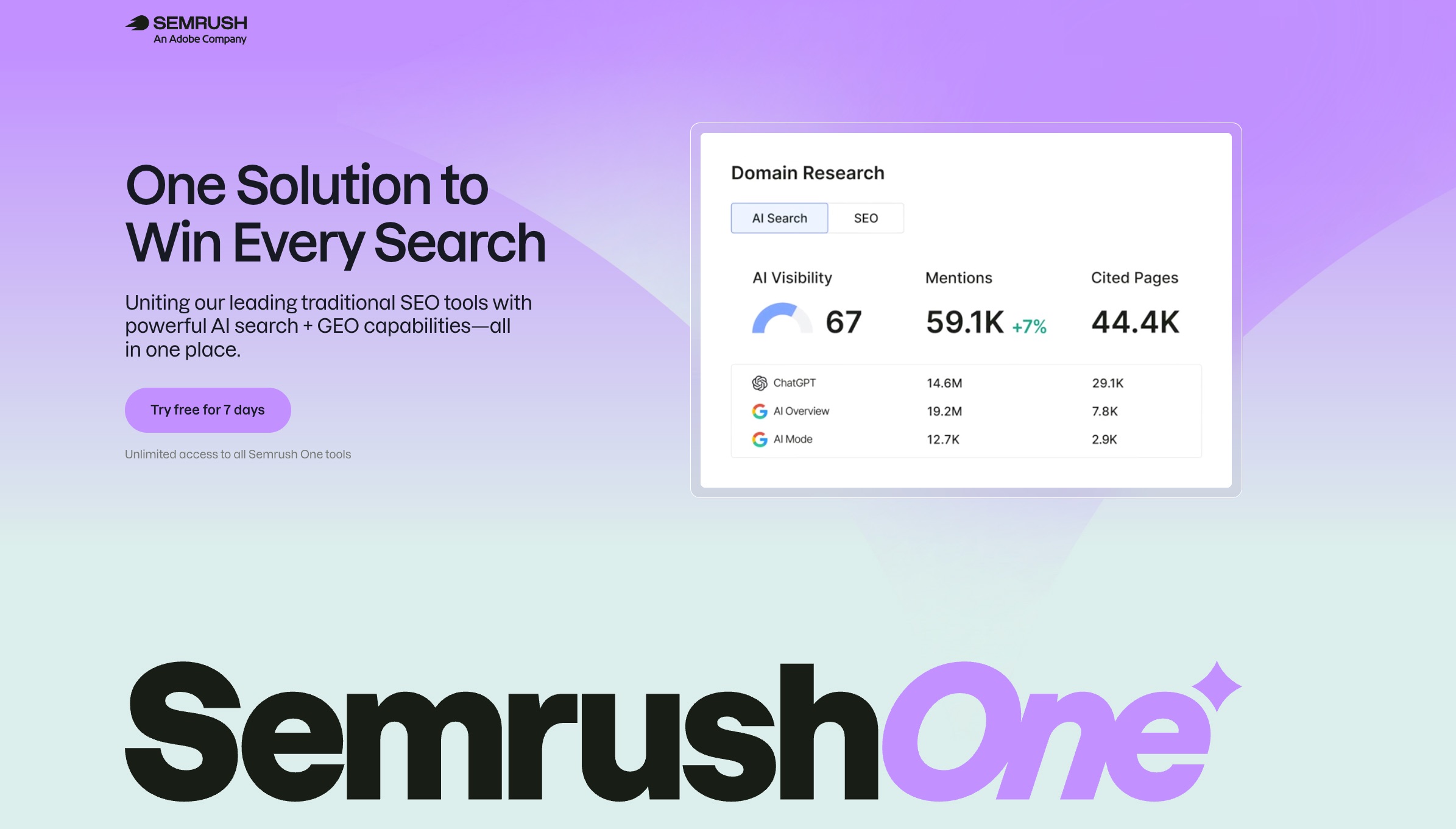
Semrush One is an all-in-one platform that unifies the SEO Toolkit with the AI Visibility Toolkit in a single workspace. Where most tools require separate subscriptions to cover traditional search and AI search, Semrush One brings both together — making it a practical choice for teams that don't want to manage multiple platforms. The AI Visibility Toolkit covers brand mentions across ChatGPT, Perplexity, Gemini, and Google AI Overviews, with Visibility Score, Share of Voice, Prompt Research, cited-source breakdowns, and sentiment analysis all included. The Question report surfaces the real queries people ask AI engines about your brand or category, making it easier to identify content gaps and prompt-level opportunities.
Good industry insights: Users like how the platform breaks down insights into scannable opportunities.
Excellent guidance: The Semrush Academy is a goldmine for creative ideas and strategies.
All-in-one platform: Semrush One combines traditional SEO and AI Visibility Toolkit in a single workspace, suitable for businesses of all sizes.
Overwhelming interface: The dashboard could feel cluttered for new users with many tools and features visible simultaneously.
Pricey: The platform can get expensive if you're an individual or small business.
Limited access on entry plans: The Starter plan covers 50 prompts, so high-volume teams will need to upgrade to Pro+ or Advanced for broader tracking.
Best for: teams that want an all-in-one platform combining traditional SEO and AI visibility in a single workspace.
Semrush One is available at three tiers:
The AI Visibility Toolkit is also available as a standalone add-on at $99/month per domain for teams that want AI tracking without the full Semrush One suite.
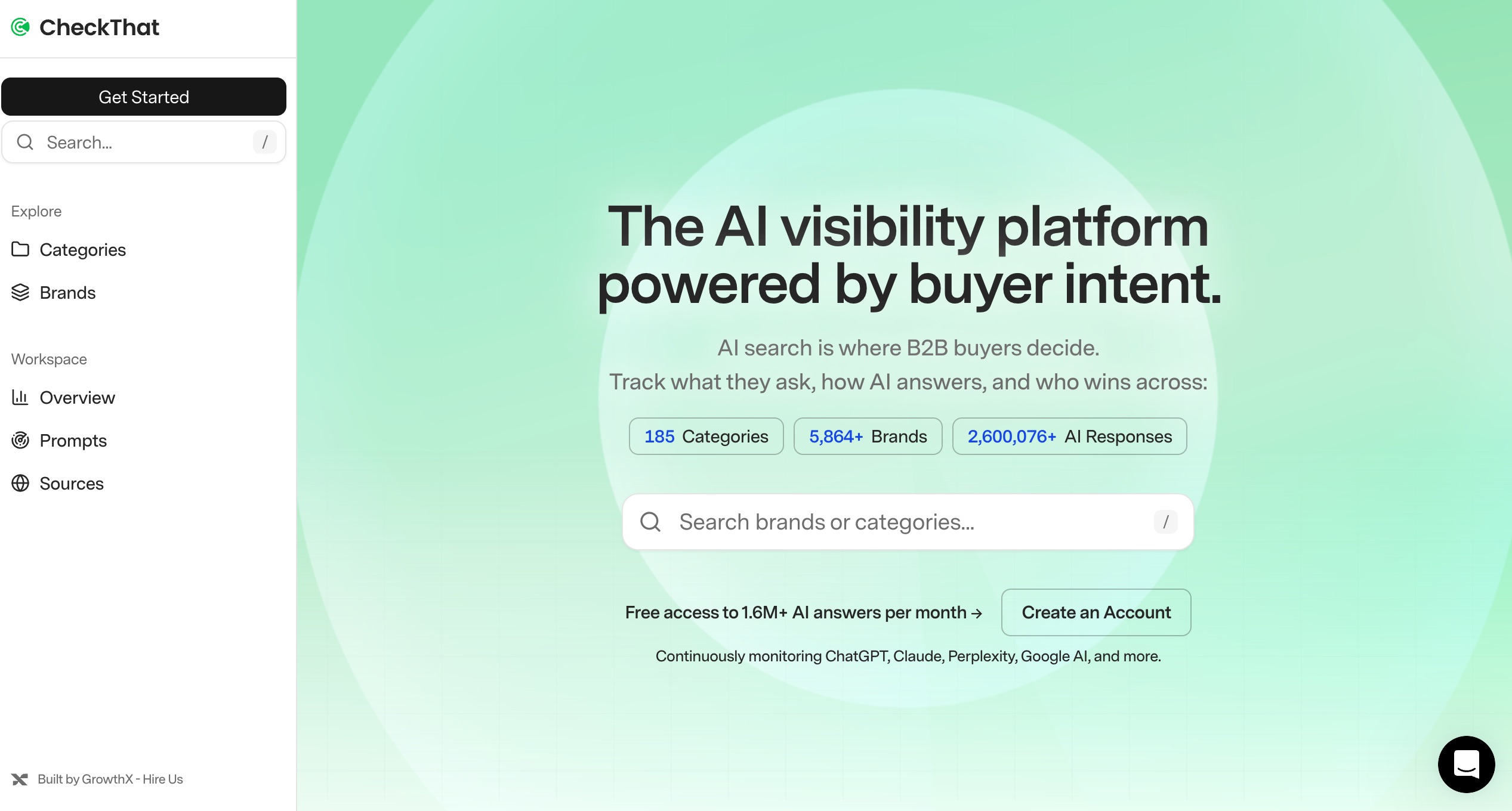
CheckThat is a free AI visibility tracking platform designed to help B2B companies understand how their brand appears in AI-generated recommendations. Built by the team behind AEO programs for Webflow, Lovable, and Ramp, the platform monitors how AI search engines respond to buyer-intent queries and which brands are recommended across software categories.
Unlike many AI visibility tools that start with an empty dashboard, CheckThat comes preloaded with 1,800+ B2B software categories, 5,800+ brands, and a shared prompt library curated around real buyer questions. Teams can browse categories like CRM, DevOps, and Foundation Models or search the brand directory to benchmark their visibility against competitors.
CheckThat continuously tracks AI responses across ChatGPT, Claude, Perplexity AI, and Google AI Mode. The free tier alone analyzes over 1.6 million AI answers per month, giving teams immediate insight into how AI models position their brand. Paid tiers add custom prompt tracking and deeper historical trend analysis for more advanced competitive intelligence.
Competitor tracking: Free and useful out of the box—no cold start. Preloaded data means you can check your brand's AI visibility in minutes.
Buyer-intent focus: Built around how B2B buyers actually ask AI for recommendations, not just generic brand-mention tracking.
Shared prompt library: Benefit from prompts curated by the team and community, rather than building everything from scratch.
Built by practitioners: Created by the team that runs AEO for Webflow, Lovable, and Ramp—real operator experience behind the product.
Broad AI model coverage: Tracks ChatGPT, Claude, Perplexity, and Google AI Mode in a single dashboard.
B2B software focus: CheckThat is purpose-built for B2B software categories, so it's not the right fit for e-commerce, media, or non-software brands.
No sentiment analysis yet: The platform shows visibility scores and competitive positioning but doesn't currently analyze brand sentiment in AI answers.
Newer platform: CheckThat is freshly launched, so some advanced features like deep historical data and custom multi-turn prompts are still rolling out.
Best for: B2B software companies that want free, out-of-the-box AI visibility benchmarking with no cold start.
CheckThat offers free access to over 1.6 million AI answers per month, including the full shared prompt library and all preloaded category data. Paid tiers unlock more custom prompt tracking and deeper historical trends. Custom pricing is available for teams that need advanced capabilities.
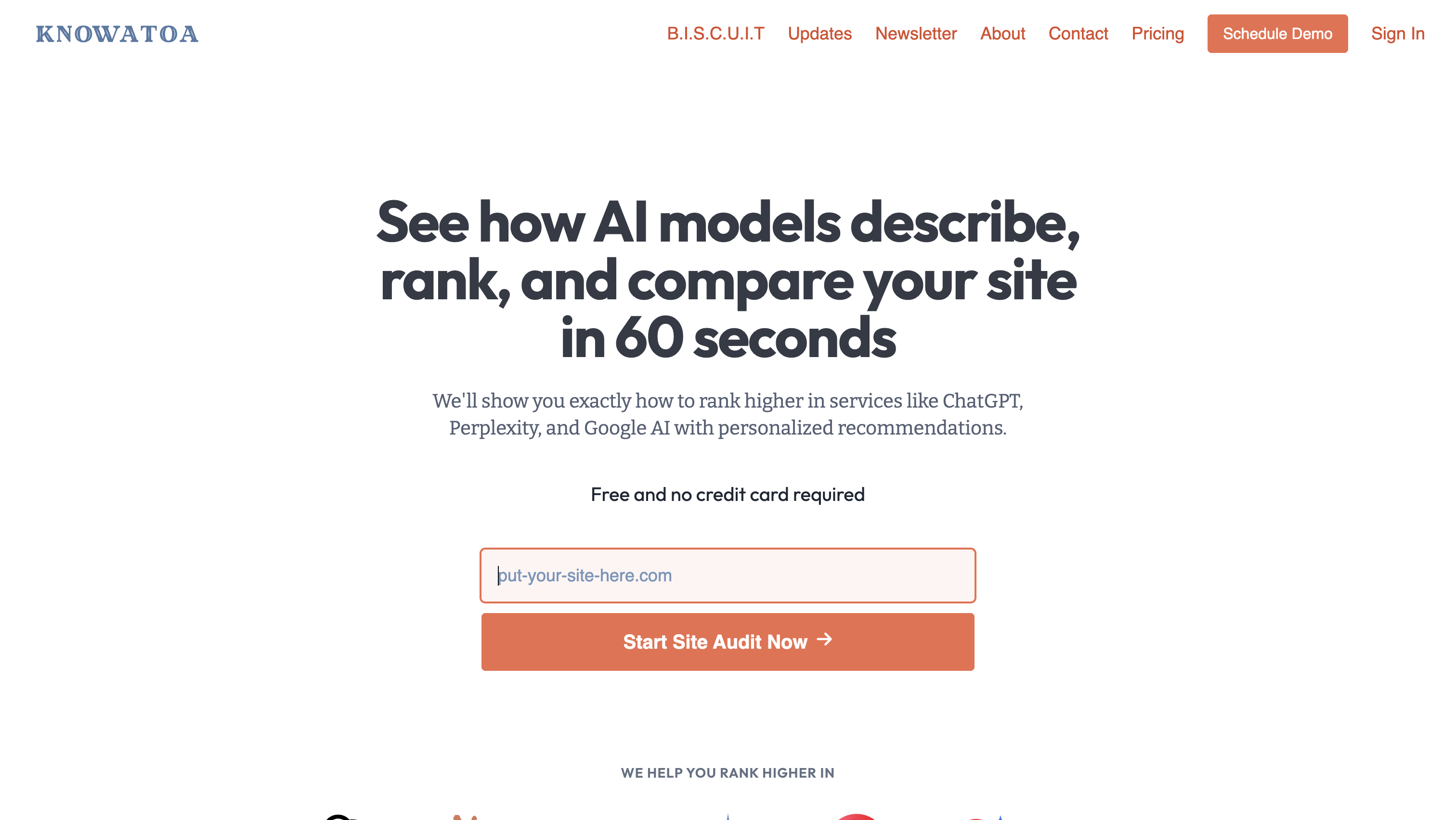
Knowatoa is an AI search visibility tool that helps businesses become discoverable and relevant in the AI search game. The platform ensures your site is AI indexable, maintains accurate data, and presents strategic opportunities for growth.
The platform compares the model results with your products and services to verify if AI is accurately representing your brand.
Intuitive interface: Knowatoa offers a clean dashboard and CSV export options.
API access: With the API, you can view real-time and historical ranking data and build custom dashboards and reporting tools.
Perplexity user-bot: This feature allows you to test if your site is read and indexed in real-time by Perplexity user bots.
Historical data views: Knowatoa shows the last five answers collected for each LLM, making it easier to visualize trends with bar graphs and charts.
No sentiment analysis: While Knowatoa reads into competitor data, it does not show how people perceive your brand.
Limited question tracking: You can track more questions only on the higher pricing tiers.
Best for: teams that want to confirm their site is AI indexable and track brand presence starting on a free plan.
This AI search visibility tool comes with a free trial and with the following pricing plans:

Xfunnel is a comprehensive AI search visibility tracking tool to scale your AI visibility. The platform lets you experiment and iterate visibility strategies, along with a dedicated analyst, should you require help.
The action-driven playbooks are created according to your goals, helping you refine your content. Plus, if you're big on affiliate marketing, you can use the ready-made affiliate lists and outreach methodologies.
Proven optimization: The action plans are based on experimentation and give you a foolproof growth strategy.
Routine check-ins: Xfunnel team routinely analyzes and tracks your experimentation to give you the best output.
Buying journey analysis: This feature helps with customer journey mapping, allowing you to see how answer engines respond to each persona.
Real-time data: Xfunnel claims to provide the highest quality data in real-time.
Missing AI models: Profound AI does not track performance across Claude, Mistral, and Grok.
Lack of resources: Xfunnel does not provide how-to guides or video tutorials, making it challenging for beginners.
No transparent pricing: The website does not explicitly state the pricing, and this means you'll never know how much you'll pay for the feature sets.
Best for: teams that want action-driven optimization playbooks and a dedicated analyst alongside visibility tracking.
The tool for AI search visibility offers two pricing tiers:
Since March 2025, AI Overviews have grown by 115%. This statistic shows how LLMs and generative AI summaries are aiding the zero-click trend.
On one hand, the LLMs are invading traditional search engine use cases, with 40% to 70% of people using them to conduct research and summarize information. On the other hand, AEO (Answer Engine Optimization) is making it more practical to retrieve information at a glance.
It's safe to say that AI search engines are now the new SERP with the visibility metrics of traditional SEO and GEO blending. This means if you don't quickly integrate with classic SEO, you might lose out on a larger customer base.
But that's not enough; you must also track brand visibility in AI search engines for a more comprehensive outlook.
Tracking tells you where you stand, but the payoff comes from acting on it. Once your tool surfaces the metrics, focus on these moves to improve visibility:
Tie each action back to the metrics your tool reports, such as share of voice, citation frequency, and prompt-level coverage, so you can measure whether your changes move the needle.
As AEO is taking over traditional SEO, it's important to start early and prioritize AI visibility tracking. The ranking factors for LLMs are very different from the traditional SERP. If you're trying to optimize for AI search, focus on multi-model support, citation worthiness, and topical depth.
The key is to test different platforms until you find the best AI search visibility tracking tool. Tools like SE Ranking, Semrush One, and Xfunnel are great for individuals and bigger companies.
In the end, you'll gain more visibility when you use the right software and consistently provide value with your content.

Irina is a Founder at ONSAAS, Growth Lead at Aura, and a SaaS marketing consultant. She helps companies to grow their revenue with SEO and inbound marketing. In her spare time, Irina entertains her cat Persie and collects airline miles.
.svg)
.svg)
.svg)
.svg)
.svg)